Twenty markets hold most of the world's hyperscale data center capacity
Northern Virginia alone accounts for 11 percent of global capacity, and power and permitting are already redrawing the list.
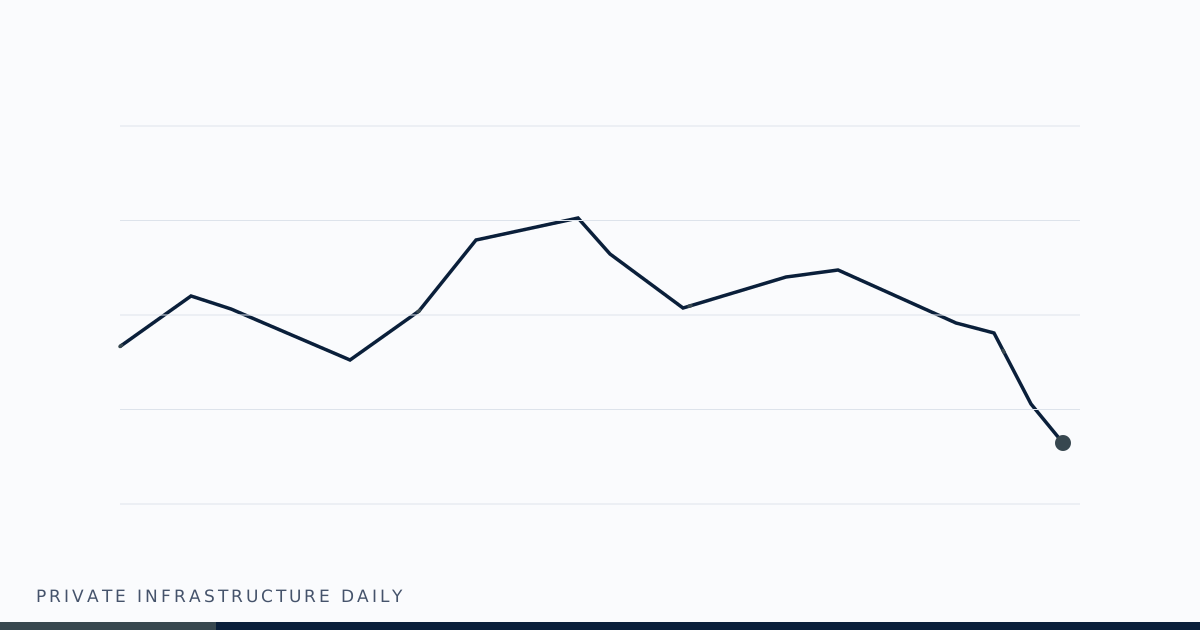
The world's hyperscale data center capacity is concentrated in twenty state or metro markets. Together they account for 60 percent of the total. Northern Virginia alone carries 11 percent, according to new data from Synergy Research Group reported by Data Center Dynamics. Beijing is second, at 6 percent.
The ranking leans heavily American: fifteen US markets appear on it. Four are in Asia-Pacific. China accounts for three of those. Europe has a single entry, Dublin. The list is deliberately short; these are the twenty places on earth where hyperscale owners have chosen to build at scale.
The list shifts. Tokyo, Sydney, and South Carolina have dropped out. Guangdong, China, plus Indiana and Tennessee in the US have taken their places. The swaps look like an industry re-sorting itself around what has become scarce.
Concentration extends beyond the top twenty. The next set consists of twenty markets. Together they add another 19 percent. Add those to the top tier and the combined two tiers hold roughly 79 percent of global capacity. That capacity sits in just 40 markets. Beyond them, capacity trails off.
Synergy Research credits the US-heavy ranking to the operators' home base. Nearly two-thirds of hyperscale operators are headquartered in the US. The US also produces close to half of cloud market revenue in key segments.
Site choice is starting to turn on a different set of questions. John Dinsdale, chief analyst at Synergy, runs through the standard site-selection variables — proximity to customers, real estate and power cost and availability, network infrastructure, ease of doing business, incentives, political stability, natural hazard exposure — then adds the new weight. "With the extremely rapid growth in demand for AI technology and infrastructure, availability of power has become an ever more critical criterion, as has the ability to overcome or work around local community objections to building large data centers." Those factors, he said, are heavily influencing where future infrastructure gets built.
Power is the locator
Dinsdale's comment carries more weight for underwriters than the ranking does. A market can hold a double-digit share of global capacity and still be difficult to build in. Keeping that share means finding power, land, and permission at a pace the grid was not designed to sustain.
The concentration data describes past decisions; power is the forecast. For allocators backing digital infrastructure, the ranking shows that the supply of acceptable sites is short and the criteria for picking them are changing. The turnover at the edges — Guangdong, Indiana, and Tennessee in; Tokyo, Sydney, and South Carolina out — suggests the search for usable power and workable permitting is already pushing capacity toward second-tier markets. Those are the places where the next fights over electricity rates and community objections are likely to land.
None of this argues for staying out of the sector. It argues for underwriting the inputs, not just the tenant. Markets that meet the test on power, land, and politics will command a premium; markets holding only one of the three will be the source of the next delays. Synergy's ranking is current only for now; it will keep moving as power and permitting decide which places can actually build.
 Digital Infra
Zayo locks in Corning fiber for 15,000-mile AI buildout
 Digital Infra
Hudson River Trading signs multi-billion-dollar AI cloud deal with CoreWeave
 The Wrap