German renewables hit a record 60.7% share of power use in first nine months
Renewables Now reports the consumption-share figure; the headline carries no breakdown by technology, owner or price.
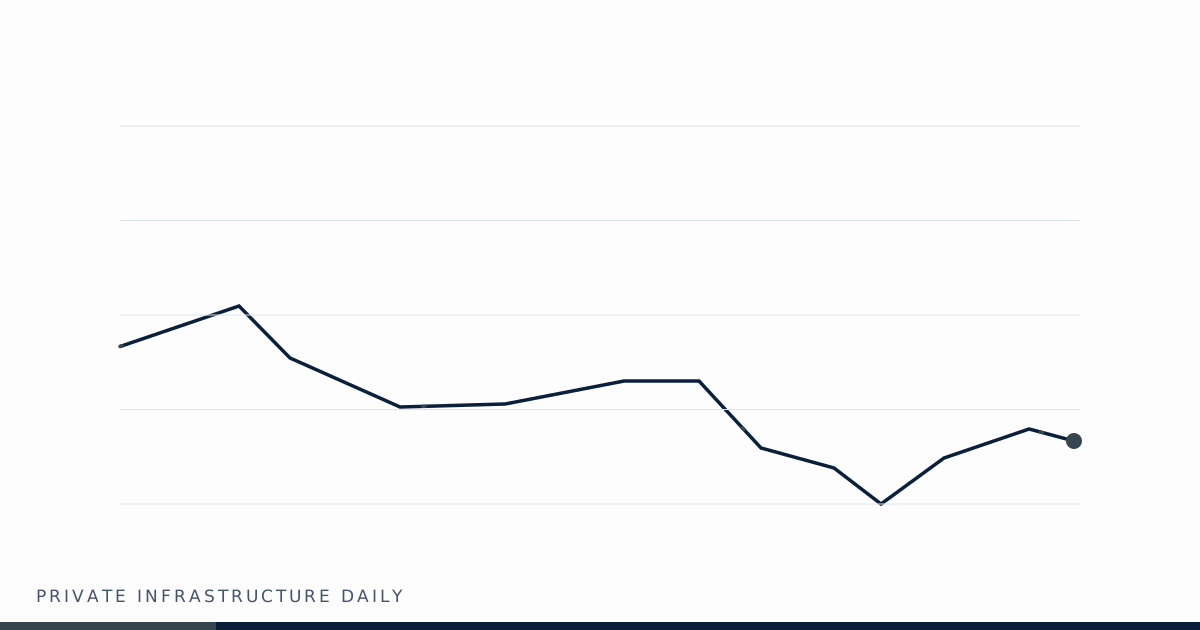
Renewables reached a record 60.7% share of German power use in January through September, the trade outlet Renewables Now reported on October 1, and the number is a ratio, one that can climb from either end. Renewable output could have risen, total consumption could have fallen, or both could have moved at once, and nothing in the published headline says which. A share rising against a shrinking base says something about demand rather than about build; a share rising on steady consumption is a supply result, and for anyone underwriting new German capacity, that difference is the whole question.
The headline is also silent on technology, where a share assembled mostly from solar hours and one assembled mostly from wind point to different needs for storage, transmission and firming, and to different capital profiles for the assets involved; the headline does not break the number down that far. What the figure does not settle is ownership, contract, or price: it is a physical outcome, a fraction of the electricity Germany used, and it is compatible with very different economics for the assets producing that electricity.
The denominator problem
This publication has argued that the transition is being repriced as an infrastructure story, with grid and firm, dispatchable capacity attracting the premium while merchant generation competes for capital on the strength of its output alone. A high and rising variable share strengthens that reading: the more weather-dependent output a system absorbs, the more valuable the wires, interconnections and firming capacity that hold it together, and the harder it becomes to earn a return on generation with no contractual claim on the value it creates. The queue, on this publication's reading, is a tariff-design problem rather than a wait-time one.
The disclosure pattern will be familiar to anyone who follows project finance, where announcements arrive with a capacity and a milestone and no owner, offtake or price, leaving the market without comparables. A national consumption share is the same habit at a larger scale: a result reported without the economics underneath it.
The number that would make the next iteration more useful is the one rarely attached to it, total power consumption, alongside the capacity and contract detail behind the supply. Until those arrive, Germany's 60.7% describes what the system delivered and leaves what it earned unstated.
Save this analysis and keep the funds you follow together in My Desk.
Sign in to save articles or follow funds. Energy Transition
Newsom signs California energy-affordability bills to expand virtual power plants
 Energy Transition
Levi's, Marks & Spencer launch Fashion Renewable Collective with Schneider Electric
 The Wrap